
Anthropic’s $431 Billion Compute Bet Tests Future Profit Margins

IPO filing exposes the challenge of matching long-term infrastructure obligations with revenue tied largely to customer usage.
Anthropic disclosed approximately $431 billion in minimum cloud-spending and equipment-lease commitments in its initial public offering filing Monday, exposing a financial risk that could determine whether its explosive revenue growth translates into sustained profitability.
The October 26 filing with the Securities and Exchange Commission reveals a mismatch between infrastructure costs committed years in advance and revenue largely determined by customer consumption. Anthropic is increasingly dependent not just on developing superior artificial intelligence models, but on ensuring that computing capacity generates enough profitable business as it becomes available.
Anthropic has demonstrated that it can substantially improve its economics despite soaring infrastructure spending. Compute and infrastructure expenses fell from 201% of revenue in the first half of 2025 to 55% a year later. The company generated $974 million in GAAP operating income in the second quarter of 2026.
Below the operating line, however, Anthropic reported a first-half net loss of $80.75 billion, driven largely by a $72.39 billion noncash fair-value adjustment involving convertible notes, derivatives and financing instruments. That accounting loss differs substantially from the operating economics of providing AI services.
The improvement in operating profitability precedes the arrival of much of Anthropic's newly contracted capacity, leaving future margins exposed to the timing of customer demand.
Commitments extend beyond current revenue
Anthropic's prospectus identifies at least $44.9 billion in minimum Microsoft cloud spending through May 2033, approximately $114.5 billion with Google through July 2033, and at least $110 billion with Amazon through April 2036.
Another $161.2 billion represents equipment-lease rent associated with Broadcom, excluding interest.
Together, these four arrangements account for approximately $430.6 billion in minimum spending and lease rent. They are not immediate liabilities, nor do they have identical payment schedules or accounting treatment.
Other disclosed arrangements involving SpaceXAI, Nscale and Lambda include maximum purchase amounts and payments conditional on capacity delivery. They cannot appropriately be added to the minimum commitments as though all amounts were unavoidable.
That distinction also helps explain why the $431 billion figure differs from the $518 billion in computing commitments previously reported from a draft prospectus by Reuters. The figures encompass different contractual categories, and the public filing contains counterparty amounts that differ from those in the earlier reporting.
The four quantified minimum arrangements are not the company's entire infrastructure exposure. Anthropic says substantially all its remaining committed spending is expected to be incurred between 2031 and 2045, although the aggregate dollar amounts and timing of those wider obligations are not fully disclosed in the preliminary prospectus.
The company typically reserves computing capacity 12 to 18 months before it becomes available. Expenses then arise as capacity enters service, potentially before the associated revenue has developed.
Anthropic's compute expense has fallen sharply relative to revenue
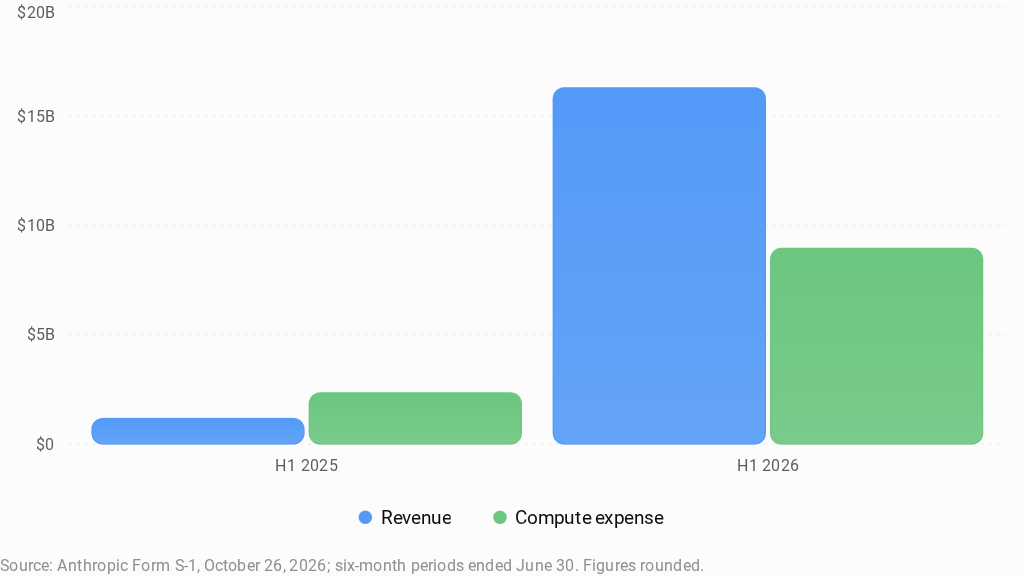
Anthropic's results illustrate both the opportunity and the risk.
Revenue rose nearly fourteenfold, from $1.16 billion in the first half of 2025 to $16.29 billion in the first half of 2026. Compute expenses increased less than fourfold, from $2.33 billion to $8.95 billion. In the second quarter alone, revenue grew 1,368% from a year earlier while compute expenses increased approximately 300%.
Anthropic also held approximately $131.7 billion in cash, cash equivalents and short-term investments at June 30. This substantial financial cushion, potentially augmented by IPO proceeds, reduces immediate financing risk even if capacity utilization falls short of expectations.
Demand is growing, but its durability remains uncertain
Anthropic's accelerating revenue offers strong evidence that advance computing reservations could become a competitive advantage.
The company reported more than 11,900 customers generating at least $100,000 in annual revenue as of September 30, including approximately 250 generating at least $10 million. Its reported net revenue retention was approximately 900%, reflecting exceptionally rapid expansion in spending by existing customers.
The central uncertainty is how reliably such growth converts into sustained demand for the capacity Anthropic has contracted.
Its revenue is primarily consumption-based, with many customers lacking long-term minimum purchasing commitments. Its five largest customers generated approximately one-quarter of revenue during the first nine months of 2026.
Customers also shift rapidly to newer models. Anthropic disclosed that models released during the preceding six months accounted for more than 80% of third-quarter revenue.
That dependence on technological progress introduces another risk: efficiency improvements and competition could reduce the amount customers pay to complete individual tasks.
Anthropic itself reports that Claude Opus 5.5 reduced customer costs per task by approximately 40% compared with Opus 5.
Lower costs can stimulate greater usage and improve profitability. But if selling prices decline faster than computing costs, Anthropic may need substantially more customer activity to generate the revenue anticipated when capacity was reserved.
Capacity shortages present the opposite risk
Excess capacity is not Anthropic's only danger.
The company disclosed that it has previously sought more computing resources from cloud providers than they were willing to supply. When long-term capacity proves insufficient, Anthropic purchases shorter-term computing resources at higher unit costs, potentially compressing margins.
Advance commitments therefore protect against lost revenue, constrained product availability and weaker competitive performance.
The company is also developing a hybrid infrastructure model that combines cloud purchases with directly leased chips hosted in dedicated facilities. This could improve cost control and allow some equipment decisions to be made closer to the date of actual demand.
For competitors such as OpenAI, the scale of Anthropic's advance reservations reinforces the importance of securing reliable computing capacity. For Amazon, Google, Microsoft and infrastructure financiers, the commitments provide visibility into future business while tying part of their commercial fortunes to Anthropic's ability to generate demand.
Investors face a more complicated calculation than simply comparing the company's obligations with current revenue.
The $8.95 billion of first-half compute expense already includes costs arising from existing infrastructure arrangements. Adding all future contractual minimums to current expenses would double-count some spending. Moreover, the commitments have different start dates, escalation patterns and durations, making a simple annual average an unreliable measure of future financial pressure.
The relevant test is whether incremental revenue generated by each new tranche of capacity exceeds its additional operating costs, after accounting for changing model efficiency and customer prices.
If compute expenses begin rising faster than revenue as newly contracted infrastructure enters service, despite continued growth in customer usage, investors will have evidence that Anthropic's infrastructure expansion is eroding rather than reinforcing its profitability.