
AI challengers close in on OpenAI and Anthropic, but their revenues may prove harder to dislodge

Moonshot's new model rivals the frontier at lower cost. Yet commercial spending remains concentrated with technological leadership.
China's Moonshot AI released Kimi K3.1 Pro on October 23, challenging the flagship artificial intelligence models of OpenAI and Anthropic with comparable performance on demanding tasks at substantially lower cost. But while rivals are capturing increasingly sophisticated workloads, most commercial spending still flows to the leading developers, suggesting that the ability to deliver superior performance remains a critical determinant of revenue.
Independent evaluator Artificial Analysis awarded Kimi K3.1 Pro an Intelligence Index score of 55, compared with 58 for Anthropic's Claude Opus 5.5 and 53 for OpenAI's GPT-6 Astra. Moonshot's previous K3 model scored 44. The index combines ten evaluations of capabilities including programming, scientific reasoning and professional knowledge work.
The new model is also considerably cheaper to operate on these tests. Artificial Analysis measured a cost of $2.11 per evaluation task for Kimi, against $3.26 for Astra and $5.98 for Opus—savings of 35% and 65%, respectively. These are benchmark execution costs, not guaranteed savings on enterprise workloads.
Kimi approaches frontier intelligence at substantially lower task cost
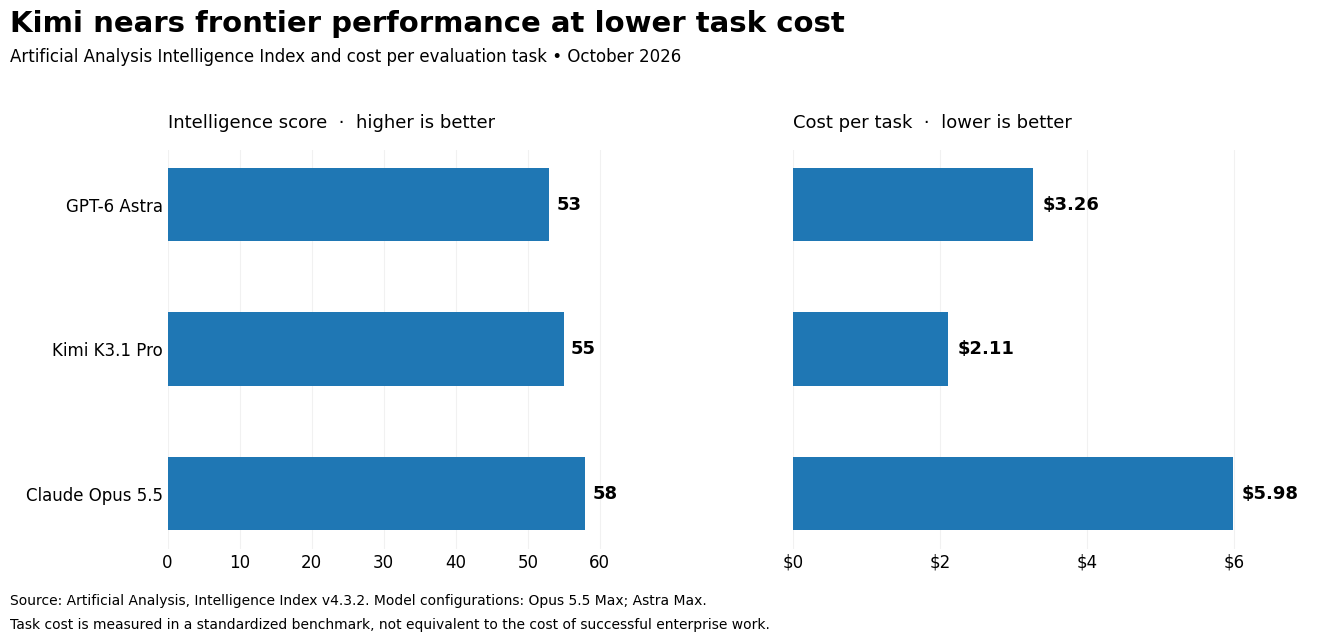
Comparison of Claude Opus 5.5, Kimi K3.1 Pro and GPT-6 Astra on Artificial Analysis Intelligence Index scores and evaluation cost per task. Source: Artificial Analysis, October 2026.
Moonshot says Kimi also nearly matches Opus in autonomous programming and has improved substantially in financial modeling, research and three-dimensional design. Its planned November 4 release of model weights would let customers deploy and customize the system without relying on Moonshot's hosted service.
The technological threat is substantial. The commercial evidence tells a more complicated story.
A lucrative market dominated by its leaders
OpenAI's annualized revenue approached $50 billion in September 2026, compared with more than $65 billion for Anthropic in July, according to Reuters, which cited people familiar with the companies' financial disclosures. Anthropic had overtaken OpenAI in quarterly revenue during the second quarter, with $11.5 billion against $6.7 billion.
Those figures dwarf the commercial scale of most challengers. Research firm Sacra estimates that Moonshot reached approximately $1 billion in annualized revenue in August, up from $300 million in June. Sacra estimates that DeepSeek reached a similar run rate in September. Neither company's figures are independently audited.
The figures are not fully comparable. OpenAI excludes certain cloud-partner sales that Anthropic includes, and annualized revenue extrapolates recent sales rather than measuring a completed year's business. The latest reported run rates also cover different months. Nevertheless, the differences in commercial scale are substantial.
Enterprise purchasing provides a more consistent comparison.
Menlo Ventures estimated that Anthropic captured 40% of enterprise foundation-model API spending in 2025, up from 12% in 2023. OpenAI's share fell from 50% to 27%, while Google's rose from 7% to 21%.
Together, those three providers accounted for an estimated 88% of enterprise foundation-model API spending in Menlo's market model, which draws on a survey of approximately 500 U.S. enterprise decision-makers. The estimate is not a measured global market share, nor is it based on audited sales.
Anthropic overtook OpenAI in enterprise foundation-model spending

Estimated shares of enterprise foundation-model API spending, 2023–2025. Show Anthropic, OpenAI, Google and other providers. Source: Menlo Ventures, State of Generative AI in the Enterprise, 2025; estimates informed by U.S. enterprise survey data.
The striking result is not merely concentration. It is how rapidly the distribution changed. Anthropic's gains coincided with the growing competitiveness of Claude, particularly in software development, where Menlo estimates that Anthropic captured 54% of enterprise spending in 2025, against 21% for OpenAI.
The evidence suggests that technological leadership can attract substantial spending—and that the resulting commercial advantage can shift between developers.
Leading AI developers dwarf challengers in reported revenue
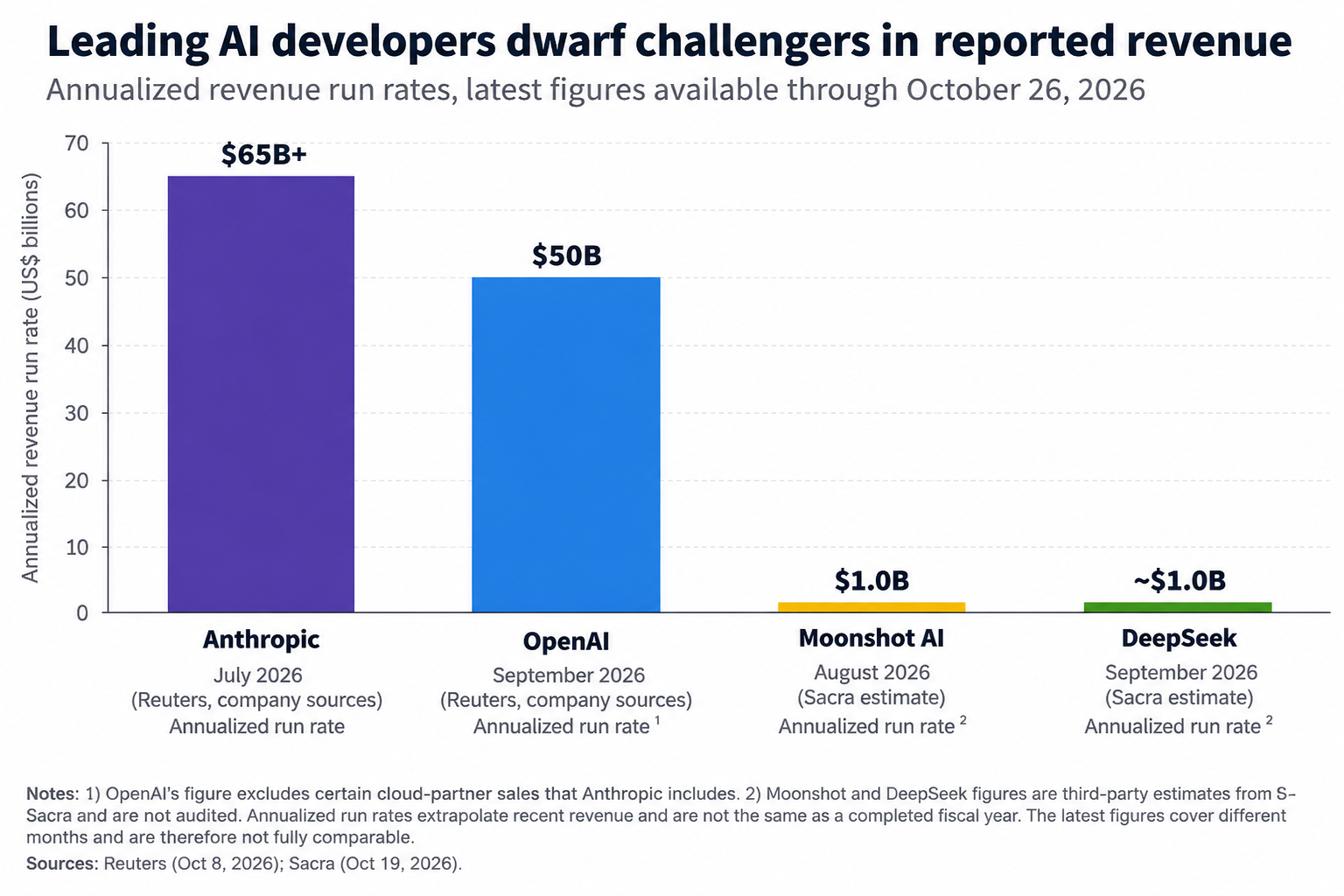
Annualized revenue run rates for Anthropic, OpenAI, Moonshot AI and DeepSeek, using the latest figures reported through October 26, 2026. Distinguish company-reported figures from third-party estimates, identify reporting months and note differences in accounting treatment. Sources: Reuters and Sacra.
Cheaper intelligence, not always cheaper results
Kimi's economics explain why the leading developers face pressure even without immediately losing their premium customers.
Moonshot charges $2 per million input tokens and $10 per million output tokens for Kimi K3.1 Pro. Opus costs $4 and $20, while Astra costs $10 and $50, respectively.
Yet comparing token prices alone exaggerates the economic differences.
Artificial Analysis found that Opus consumed approximately 260 million output tokens to complete its Intelligence Index evaluation, against 148 million for Kimi and 60 million for Astra.
That helps explain why Opus costs more per evaluation task than Astra despite having a lower token tariff. More extensive reasoning can require substantially greater computational expenditure, and cheaper tokens do not automatically produce cheaper results.
A buyer choosing among these models therefore faces two questions: which can complete the assignment, and what does successful completion cost?
For routine document processing, customer support or standardized coding, a lower-priced model that reliably meets requirements can be economically superior. For difficult engineering, financial analysis or autonomous work, a small performance advantage may justify a substantial premium if it avoids failed attempts, corrections or human supervision.
Kimi's progress is most threatening where the performance difference has become commercially irrelevant.
Customers are increasingly willing to switch
Enterprise AI customers are showing a growing willingness to change providers, challenging the assumption that established commercial relationships will protect the leading developers.
Payments company Ramp reported on October 6 that the share of businesses changing AI model providers, measured as a three-month moving average, reached a record 8% in September. Ramp linked earlier changes in switching behavior to Anthropic's model improvements and OpenAI's subsequent releases and price reductions.
The infrastructure for switching is also improving. Google Cloud announced expanded access to OpenAI and Anthropic models in October, giving enterprises more opportunities to compare and purchase competing systems through established commercial relationships.
Moonshot has pursued a similar route through inference providers that serve business customers. Sacra reports that it shares revenue with hosting partners, allowing it to reach customers through established platforms without building every commercial relationship directly.
This reduces the protection that enterprise integration and established distribution channels afford leading developers.
It also challenges a simple division between expensive frontier models and cheap commodity alternatives. The company selling an inexpensive model today can use its customer relationships, knowledge of customer workloads and research advances to compete for premium business tomorrow.
Anthropic's rise at OpenAI's expense provides evidence of that mechanism. Customers are willing to redirect spending when competing models offer greater value.
The revenue advantage depends on staying ahead
The evidence supports an emerging distinction between the volume of intelligence consumed and the economic value captured from it.
Low-cost models can process enormous quantities of routine work without generating comparable revenue. Premium models can retain disproportionate spending if their superior capabilities enable customers to accomplish tasks that cheaper alternatives cannot reliably complete.
That distinction is commercially important because building frontier models requires extraordinary investment. OpenAI has projected approximately $50 billion in computing expenditure for 2026, while reporting reviewed by Reuters indicates that Anthropic spent nearly $9 billion on computing and infrastructure in the first half.
Maintaining leadership is expensive. Losing it could be more expensive still.
The evidence does not establish that frontier providers enjoy durable profit margins. Their computing costs are rising, and neither substantial revenue nor a strong benchmark score guarantees attractive returns on the capital required to produce them.
Nor does it establish that challengers will remain confined to inexpensive work. Kimi's 11-point improvement on the Artificial Analysis index demonstrates how much capability can change between releases.
The strongest alternative to a two-tier market is broad commoditization: cheaper models become reliable enough for nearly every economically valuable task, eliminating much of the premium associated with frontier performance. A second possibility is repeated leadership turnover, with the premium moving rapidly among competing developers.
For now, enterprise model spending remains concentrated among a few providers, even as technological capability spreads and customers become more willing to switch.
OpenAI and Anthropic can defend their premium revenues as long as their strongest models deliver advantages that customers value enough to pay for. Their competitive positions are less secure than their revenue figures suggest, however, because the same market evidence shows that technological leadership can change—and spending can change with it.
Moonshot has shown how close a challenger can come. The decisive test is whether it, or another rival, can move ahead.
Sources
- Moonshot AI: Kimi K3.1 Pro release documentation, October 23, 2026.
- Artificial Analysis: Kimi K3.1 Pro versus Claude Opus 5.5, Intelligence Index v4.3.2.
- Menlo Ventures: State of Generative AI in the Enterprise, 2025.
- Reuters: OpenAI's September annualized revenue approaches $50 billion, October 8, 2026.
- Sacra: Moonshot AI versus DeepSeek, October 19, 2026.
- Ramp: Businesses are changing AI model providers more often, October 6, 2026.
- Google Cloud: Expanded availability of OpenAI models, October 21, 2026.